
We Are Paintings
Review of >> The Touch Report by Katrina Palmer
The Touch Report, Katrina Palmer, BookWorks, 2024.
The most immediately striking aspect of this BookWorks publication which resulted from the sculptor Katrina Palmer’s residency at the National Gallery, is its vast amount of white space. Verso pages are invariably left blank, while the rectos typically feature a few lines of ekphrasis at the lower end. Display of the white page goes hand in hand with an emphasis throughout on the theme of darkness; also evident in the textual design. In the top section of the recto—dealing with the shifting perspectives of the semi-fictional figure of the Writer-in-Residence—white text is set against black bars, reminiscent of redaction. This playing off of the print against its substrate points up black and white as colour values. While the passages describing the paintings mainly focus on two colours: red, usually in the form of blood, and a generous smattering of gold for crowns, halos and the glint of weaponry. Blood and gold: a shorthand for the Western tradition at its intersection of violence and wealth.
Turning one virginally blank page after another, one is reminded that BookWorks uses only topnotch, acid-free, archive-quality paper. As any writer or publisher cannot help but be aware—due to a perfect storm of the rising costs of energy and raw material plus the pandemic and Brexit-induced logistical issues—the price of paper has significantly increased over the last few years. The intended effect may have been a minimalist asceticism, in keeping with the project of sidestepping the visual allure of the paintings. However, in the process of reading The Touch Report its conspicuous consumption of white space becomes analogous to the use of gold leaf in the paintings.
By providing space between the descriptions of the paintings, the sumptuous expanse of verso pages also doubles the function of the gallery wall. The reader is given a virtual tour through the entire gallery, not only its display rooms but also its storerooms, its conservation studio and art-handling room.
The ekphrastic sections all begin with the word “Here”; this lead-in, which highlights the immediacy of painting is the same tactic as that employed by classical ekphrasis. Philostratus the Elder, writing circa third century AD describes a painting in these terms: Here are the gifts of the cherry tree. Here is whole harvest of grapes in a basket. Seventeen hundred odd years later, the post-structuralist philosopher Gilles Deleuze writes: Why is it that when critics speak about painting there is always a word everybody uses – the theme of presence? Presence, presence, it’s the simplest word to describe the effect of painting on us. Or, as Francis Bacon, one of Deleuze’s favourite painters, so pungently put it: The painter leaves a trace as the snail leaves its slime.
The classical convention of ekphrasis subscribes to the credo of Horace’s famous epigram: “As in painting so in poetry”, derived from the belief that visual art could be seamlessly translated into the verbal medium. Palmer’s descriptive approach however, consists in stripping the paintings of their mytho-theological codes in order to produce starkly realized tableaux of violent interactions. A sentence typically reads: Here a woman kneels in front of a man who raises his right arm to reveal the blood that gushes from the puncture wound at the centre of his palm. While the crucifixion scene itself is invoked by the blunt formula: Here a man nailed to the cross. This phrase is so copiously repeated throughout the book that it becomes a form of punctuation. Palmer’s bare-bones description verges on anti-ekphrasis, which serves her avowed intention to demystify the National Gallery collection in order to focus the viewer’s attention on the violence that is depicted. When The Touch Report was exhibited in Room 17a of the gallery, the paintings usually on display were removed to shield the public’s gaze from their dazzling surfaces. Reading the book in a space emptied out of images and thus cleansed of the distraction of retinal fascination, visitors were encouraged to participate in an experience of kenosis. However, peeling away the veil of myth and religion and eliding the aesthetic allure of the art actually works to highlight the irreducibility of the Western heritage, however rudimentary its code. A man nailed to a cross is all it takes to invoke the entire religious tradition. As the minimalist painter Brice Marsden says: The rectangle, the plane, the structure, the picture, are but sounding boards for the spirit. The metaphysical is hardwired into the structural DNA of painting and, as The Touch Report attests, the mystique of painting is not so easily exorcised.
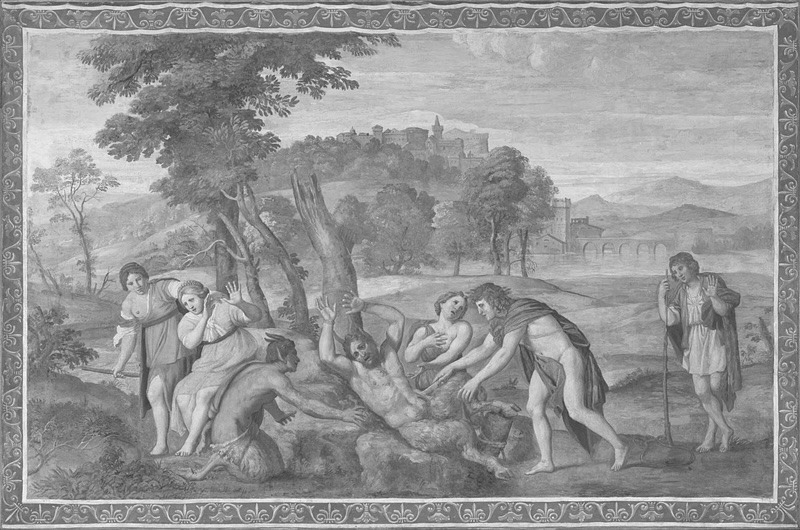
The opening paragraph of the book describes a fresco depicting the flaying of Marsyas—a figure which, as it becomes gradually apparent in the course of the book, underlies all painting. The fresco reappears about halfway through the book, in an account of its transposition from its original site to the National Gallery. As Palmer’s avatar, The Writer-in-Residence, comments: Discover that this fresco, with its vicious portrayal of skinning, was itself stripped from its foundation at its original site. Because the painting was merged with the plaster wall, the task of detaching was one of precise aggression, involving the application of a specially-developed adhesive that effectively sucked the colour out of the lime. It was then possible to peel off the thin skin of paint alone, leaving raw plaster behind. The painting becomes the flayed figure, becomes Marsyas, and so takes on a mortal quality. In her novel The Baudelaire Fractal, Lisa Robertson describes how, standing in front of a painting, the protagonist undergoes an experience of visceral correspondence: ...a mute mineral affinity...a deferred material telepathy, an elemental magnetism. I was noticing a sympathy of my body’s iron and copper and calcium towards paint...The change had to do with the deepening sensation of interior space by means of immaterial correspondences. Pigment striates the subject. Mineral affinities act within and across bodies and times. We are paintings.
The peeling away of the fresco depicting the flaying of Marsyas segues into a recurring motif of the exposure of (mainly) female body parts. These images culminate in an account of the restoration of the damaged surface of Titian’s ‘Bacchus and Ariadne’, a jewel in the crown of the National Gallery collection. This painting which, despite herself, gets under the skin of the Writer-in-Residence reappears more than once, as it shifts from ascetic ekphrasis on the lower half of the page, to the white-on-black text, where it takes on a speculative and allegorical edge. Here again the woman waving, turning. She looks over her shoulder, not waving but pressing her hand into the painted surface, pushing against the thin veneer of sky, testing its capacity to sustain her, disturbed by the possibility that the man, who tries to throw himself at her, will burst through the semblance of the place they subsist in.
Despite yourself, repeatedly stand in front of this painting.
There follows a detailed account of restoration work carried out on the painting through the nineteenth to early twentieth century, of the damage incurred during its initial transition from Ferrara to Rome. The account ends with a fusion of material and narrative instability. Realise that no one has attempted to continue the work since 1967 but attentive present-day conservators consider the painting as very fragile. To reach the paint, to even begin restoration would involve removing every layer of re-touching from the front and simultaneously detaching the panel and lining from the back, exposing the tenuous web of canvas onto which the remaining paint clings. So, for the time being, it’s held in place, suspended behind glass and at the risk of material incoherence, just as the depicted subjects approach a loss of control.
The painting has another, final layer to reveal; on the back of the canvas there is a line drawing, invisible to the naked eye but apparent under ultra-violet light. This occluded image probably depicts an enslaved woman. Her reveal constitutes the return of the repressed and a moment of darkness made visible.
When an unspecified offstage accident damages her writing arm, the Writer-in-Residence wraps the arm in bandages and plaster, building it up layer by sculptural layer. Earlier, she attempted to photograph: ...every puffed sleeve and every weapon on display and notes that the sleeves of the costumes are ornate and voluminous...The inflated limb is frequently encountered as if bursting out of the painting and into the room. Now, she has her own hugely inflated sleeve which, she comes to realise, is akin to a phallus and thereby connected to the recurring motif of “phallic sword-hilts”. The plaster-arm takes on a surreal life of its own: The plaster sleeve will be too heavy to lift but you insist on writing with your massive writing arm because you’re so fucking pompous. As this tips over into hyperbolic bathos, the Writer-in-Residence herself becomes an exhibit. Weighed down by the burden of Western Civilisation as she guides us through the gallery, she evokes a Quasimodo-like figure. The plaster-arm does a lot of symbolic heavy lifting.
The narrative device of the Writer-in-Residence allows Palmer to dramatize the struggle entailed in compiling this catalogue of sexualised violence. It suggests an attempt to model a certain ambivalence about occupying the role of privileged viewer of these paintings which stir her, despite herself. With all-areas and out of hours access, the Writer-in- Residence is implicated as a voyeur. The very first sentence of The Touch Report reads: “Here a woman steps into view at the edge of the frame”. At the beginning of the next paragraph we are told: “This woman, who is still on one side, sees everything.” And the last sentence of this section: “Not entering the action or moving away, she holds her nerve.” The emphasis on a peripheral figure in the Marsyas fresco placed right at the start of the book sets up a surrogate viewer/voyeur, as the author seeks to position herself in relation to the appalling scene which the fresco depicts.
Voyeur, stocktaker, guide, wounded hysteric, host and scribe, The Writer-in-Residence is something of a catch-all figure who’s point of view is everywhere and nowhere at once Lacking a stable perspective, this device tends to detract from the through-line traced above, leading from the flaying of Marsyas to the discovery of the line drawing on the back of the Titian canvas. It therefore takes more than one reading for the drama of the book’s dialectic to become apparent.
According to the phenomenologist Merleau-Ponty, once placed in a gallery or museum, paintings become muted, their “vehemence” diminished. In the last two passages Palmer dispenses with her austere, stilted approach and surrenders to the forcefield of painting to produce virtuoso ekphrases. These passages, replete with vehemence, arrive heralded by occasional references in the second half of the book to cries being emitted by the paintings. Here a woman with long red-orange hair and an amber-red dress falls, or is pulled backwards, into the redness of the room; a context that simultaneously supports and threatens to subsume her… The intermingling of the forms is as intimate as the action; the chair is the body, is the curtain, is the wallpaper, is the dress and the hair that spans from one woman’s head to the other’s pubis...These entangled figures of different status are held together, drawn back into the amorphous blood mist. In this account of Dégas’ ‘The Combing of the Hair’ there is a dissolution of boundaries, not only between the forms within the painting, but also between it and the viewer, who is almost literally splashed by the pigments. It exemplifies the effective affect of painting, as formulated by Stephen Bann in The True Vine, namely: The way in which the painted surface offers itself up to us, and indeed reaches out towards us to entangle us...the momentum with which the work threatens to tip over into direct assault on the viewer’s bodily space. This momentum is developed in the final, extended ekphrasis dealing once again with Titian’s ‘Bacchus and Ariadne’, where Ariadne seems to break the fourth wall of the painting: Her hand doesn’t wave after all but presses into the sky, indicating the material, the practical limits of their universe. She touches the paint.
Merleau-Ponty’s term “vehemence” speaks to the Deleuzian concept of the “force of painting” which is bound up with that of “the chaos or catastrophe germ”— the necessary loss of mastery the painter undergoes while in the thick of the creative process:...this theme that traverses all the painters, that they situate themselves in terms of the creation of the world….What would that mean but precisely that they pass through this chaos catastrophe, introducing it onto the canvas so that something may emerge from it, that is the world not of objects but of light, of colour…The catastrophe is the place of forces. In The Logic of Sensation, Deleuze’s study of the work of Francis Bacon, the catastrophe germ is referred to as chance or accident, like that which befalls the Writer-in-Residence’s writing arm.
The Touch Report takes it cue from the National Gallery’s record of the incidents of when an artwork on display is touched by a member of the public. The focus of this extraordinary book however, is on the way in which we ourselves are touched by the forcefield of painting. This does not inhere in any particular image the painting represents, nor is it in the pigments per se—but in that liminal space where the two dimensional surface projects. “Not its datum but its factum” as Deleuze puts it. Between the canvas and the viewer; there, where light takes on its haptic, sculptural aspect, is where the pictorial fact operates.
Works cited:
The Touch Report, Katrina Palmer, Book Works 2025.
The Baudelaire Fractal, Lisa Robertson, Peninsula Press 2020.
The True Vine: On Visual Representation and the Western Tradition, Stephen Bann, Cambridge University Press 1989.
'Painting and Question of Concepts'- transcript of a seminar by Gilles Deleuze 1981 available at: https://deleuze.cla.purdue.edu/seminar/painting-and-question-concepts/
Francis Bacon: The Logic of Sensation, Gilles Deleuze, tr. Daniel W. Smith, Continuum, 1981.
The Prose of the World, Maurice Merleau-Ponty, tr. John O’Neill, Northwestern University Press, 1973.
//
Karen Whiteson’s ficto-critical novella about a painter titled In the Direction of the Wound will be published by Splice in 2027. Her review of Katrina Palmer’s 2015 book End Matter appeared on Soanyway magazine:https://www.soanywaymagazine.org/reviews. She lives in London.
[image: The Flaying of Marsyas, Domenichino and assistants ca. 1616-18] ]
Sheffield, UK