
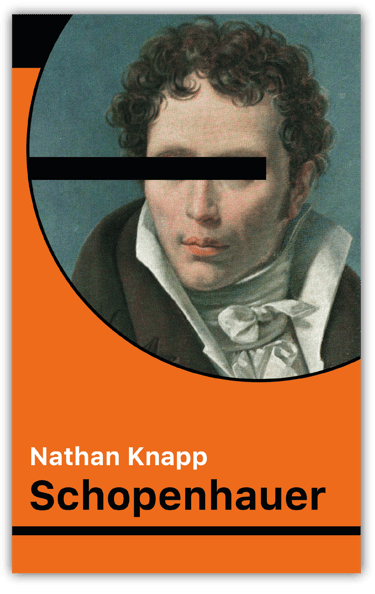
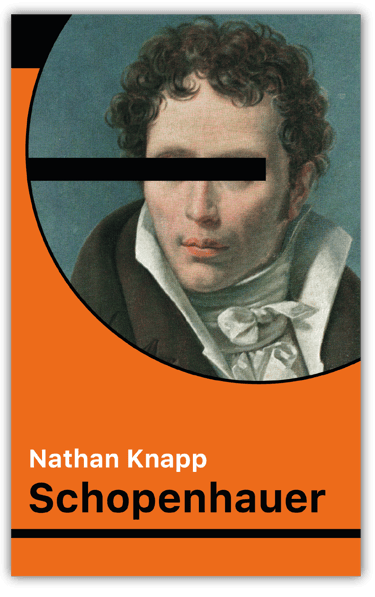
Schopenhauer
Nathan Knapp
2026
Schopenhauer—how to describe it? As a biography? The book’s titular character would object to that—then again, he objects to most things. Should we call it a novel? Let us call it a novel. We can at least with some certainty say that the book tells the story of one of the foremost pessimists in all of human history. And that if he were in charge, or so he tells us, he would do things differently. Yes: when he is in charge, he says, he is going to do things differently.
And yet he has questions. And so do we. Why is A. Schopenhauer in an apartment in Seattle eating Chinese takeout and watching Howard Hawks’s Rio Bravo? Why at an abstinence rally in rural Oklahoma? Why, momentarily, at an Easter dinner? Why, for that matter, alone in a spaceship with Jesus, orbiting a hellish planet that rains rocks? And why does Jesus have John the Baptist’s head in a box? (Because, Jesus says—well, we’d better not say, at least not here.)
What is A. Schopenhauer doing at the Battle of Little Bighorn, or, after a certain famous public execution, trapped inside a tomb just beyond Golgotha, or in Hell—where he admittedly probably belongs? What is he doing at a so-called literary festival in America? Why does he get such prodigious nose-bleeds? Why is getting a haircut, for him, such an issue? Why can’t he remember how to tie his shoes?
He doesn’t know. That’s the whole problem. Then again: none of us know why we are where we are either. A. Schopenhauer, though, has a fool-proof plan: when he figures out who’s responsible, he’s going to make them pay for it. Oh God yes. He is going to make them pay.
//
Praise for Nathan Knapp’s previous novel, Daybook, published by Splice in 2024 and long-listed for the 2025 Republic of Consciousness Prize:
“[Daybook] is one of the best pieces of contemporary writing I’ve read in the last few years.”
—Dmitry Samarov, in a review for Maudlin House
“Daybook is called a daybook and is punctuated, more or less, by days—but days that are turned back on themselves, revisited, reinterrogated, and inverted until time becomes both a willful vector and the still point around which the book revolves. The very spaces between the sentences are heavy with unspoken movement. Many questions are asked, some are never answered, some are answered so many times that they revert to questions. You don’t know where you are and you know exactly, which is only and precisely what a great novel does.”
—Emily Hall, author of The Long Cut
“Flaubert famously wanted to one day write a book about nothing, and although Nathan Knapp's Daybook isn't that exactly, it is, I think, precisely the kind of book that Flaubert would nevertheless have admired: oddly propulsive by virtue of its prose, devoid of received and insincere ideas, resistant to facile reduction, new. A book like this one—a book that asks its reader to reflect critically on how they've spent their limited time alive while also reassuring its reader their time has been well spent in reading it—is exceedingly rare.”
—Gabriel Blackwell, author of COMMENT SECTION and Doom Town
“Daybook is a brilliant, swirling evocation of time and memory and, perhaps most of all, what it means to transform thought into writing. Nathan Knapp has written a funny, inventive and haunting book.”
—Jess Walter, author of So Far Gone, The Cold Millions, and The Zero
“Can a book be haunted and exuberant at the same time? Can it be funny and the saddest thing you’ve ever read? Can it feel like it was improvised live on stage while its sentences were chiseled in stone? I don’t know how Nathan Knapp pulled this off, but the result is exactly what I’m always looking for: An absolutely one-of-a-kind book that held me rapt from the first word to the last.”
—Ben Loory, author of Tales of Falling and Flying
ISBN 978-1-916541-31-3 // also via retailers inc. Bookshop.org, Barnes&Noble, Waterstones, Foyles, Walmart, Blackwells & Booktopia. // Launch video
Sheffield, UK