
Pissoir
Review of >> Nietzsche: The Unmanned Autohagiography by D. Harlan Wilson
Nietzsche: The Unmanned Autohagiography, D. Harlan Wilson, Raw Dog Screaming Press, 2023.
In Nietzsche: The Unmanned Autohagiography D. Harlan Wilson provides “a remarkable exploration of Friedrich Nietzsche’s Native American roots…based in extensive research in the Nietzsche Archives”. Or so it says on the back cover.
Perhaps unsurprisingly, Nietzschean scholarship does not take priority. Rather, Nietzsche serves to animate and drive the text with the book having a whole lot more to say about the narrator himself (hence the autohagiography of the title) and other connected topics such as the various travails of being a Professor/Author in his unfortunate posting as Chair of the “Human Stain Department” (40), meaning the ‘humanities’ department at which he works.
Evidently, this university professor is ‘a very impressive man’. But nothing is quite as it seems and autohagiography is only presented as a viable form because it is (never to an amount it will fully reveal) self-undermining. For instance: “This book is not an autohagiography any more than this avowal is not a disclaimer or a non-reliance clause” (26).
So, fairly little Nietzsche at first sight, lots about the Prof.
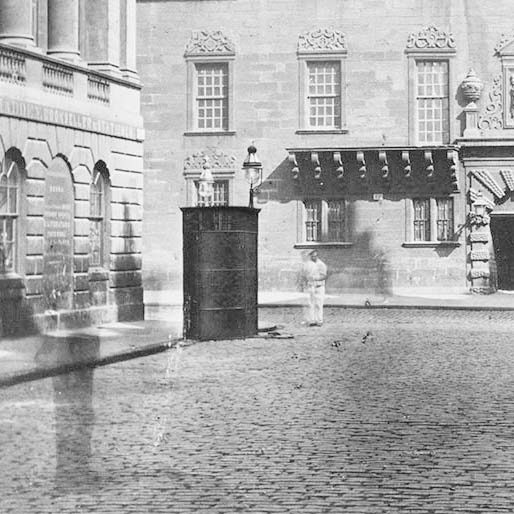
There is towards the end of the book (within the ‘Aborted Chapters’) a picture of Nietzsche taking a leak at an outdoor pissoir: “One intoxicated afternoon, Nietzsche’s personal assistant Stanley Ashenbach photographed him micturating in a pissoir near a celebrated Leipzig discotheque”, is how the picture is captioned (130).
And the exact timbre of Nietzsche’s voice is also described, not from a recording (none was found) but via “trace amounts of cellular material (Touch DNA) from books that belonged to him” (42). The wonders of science.
This book is one of the better forms of nonsense that has been projected from a system (the university system) which is built on the stuff, these days at least. For indeed this book represents a species of institutional critique at its most ebullient, and is, as a form of scholarship, sufficient evidence of how deliberately and obviously fabricating textual material provides a space for criticism that is also a space of liberation, or at least, suspension—in which some of the rules of an overbearing, if not authoritarian, perhaps fascistic reality are suspended.
Curiously, this endeavour is explicitly framed by Wilson’s book in relation to the archive, or some notion of the archive, which somehow manages to sanction such mischief (this was all based on extensive archival research after all). This text might be placed at the outer fringe of the so-called archival turn in the arts and humanities, a conceptual shift towards treating the archive as an active, constitutive force, a constitutive force that has, in this case, entirely separated itself off from the restraints of evidence and scholarly propriety.
Otherwise put, this book is set about messing with you, and the narrator is doing rather well out of being such a likeable jerk (have I used that word right? it’s not my idiom). Actually, the more I read, the more I like him. Which is part of my thesis, coming next.
The protagonist of The Unmanned Autohagiography is so likeable (to my mind) because he is such a flagrant arsehole. Well, much of the time. Confusingly, he often also presents as a rather nice guy. After having this thought (about the arsehole not the nice guy) I did check in the D. Harlan Wilson archive and there is an interview in which the question was put: “Is ‘Assholery’ a technical term?” to which Wilson replied: “I don’t think so, but it’s certainly viable.”[1]
Technically, then: He is the Chief arsehole of a Human Stain Department within a university system that is made up of variations on the theme (“embodying all the worst qualities of the human condition”, 31). And the book provides a rough taxonomy ranging from the protagonist himself, an overperforming arsehole, to the “inept, bitter underperformers” who are predominant (25). But he takes this arseholery beyond the usual limits within which even the overperforming arsehole is expressed. He inflates and distends it, makes an art of it, presents it and at the same time undermines it (not by being nice, exactly, but by being inconsistent and by employing the techniques of the unreliable narrator, or in this case, unreliable arse, sorry). Which means, he cannot be an arsehole, not really, he is not truly an arsehole, he has actually exceeded the arsehole in arseholery, and as such might actually have become the mime of an arsehole in the sense Hal Foster uses that term (mime not arsehole) when writing about Hugo Ball.
“A key persona of Dada…is the traumatic mime…whereby the Dadist assumes the dire conditions of his time—the armoring of the military body, the fragmenting of the industrial worker, the commodifying of the capitalist subject—and inflates them beyond hyperbole” (169).[2]
The traumatic mime, Foster continues, “virtualized this figure of dehumanization as a form of defence—against world war, brutal industrialization, nationalist madness, repressive government”. The protagonist of The Unmanned Autohagiography may be considered in a similar manner, that is, as the traumatic mime of all the arseholery of a university system, a system bent on dehumanising those it was supposed to protect, foster even, perhaps cultivate, in order to perpetuate that three-thousand-year legacy of a ‘humanistic’ civilization that has repeatedly crushed the very things it praised, as Dada noted long before the late-20th/early-21st century university crushed it all again. As its mime, Wilson’s arsehole follows the same lineage, wherein the Dadaist “is a man without a man; the opposite of the Super-Man, he is an Un-man”.[3] And so much the better.
-
[1] Sex, Drugs & Av ‘n’ Garde with D. Harlan Wilson, Novelle January 17, 2018.
[2] Hal Foster, ‘Dada Mime’, October 105, 2003, p. 169.
[3] Ibid. p. 175.
//
Ansgar Allen is the author of books including a short history of Cynicism, and the novels, Black Vellum, Plague Theatre, The Wake and the Manuscript and The Sick List.
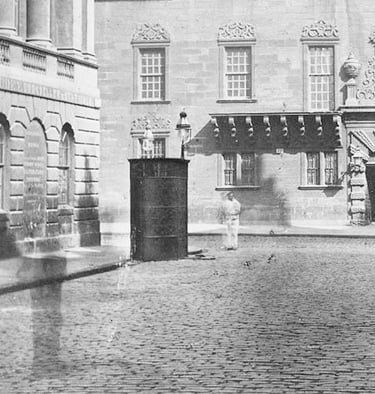
[image: A cast iron urinal or 'pissoir' in College Street, Glasgow, 1866]

Sheffield, UK